We caught up with three current PhD students in the Department of English, to find out what they’re studying, writing and how they spend their days. Read more in this Q&A.
Caite Dolan-Leach
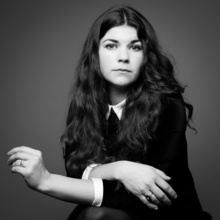
Caite Dolan-Leach is originally from the Finger Lakes region in upstate New York. Before starting a PhD in the Department of English, she worked as a novelist. She has three novels published with Random House, and a fourth currently in submission. She completed her undergraduate degree at Trinity College Dublin and earned a master's degree in cultural translation from the American University of Paris. She has co-translated two novels from French and also works in Italian translation.
What brought you to the University of Iowa?
I had already been living in Iowa City for several years before starting the PhD. I'd been here writing for several years, and then taught a few semesters in the translation department. I'd also been involved with the International Writing Program. At some point, it just seemed like I should get a doctorate while I was at it!
What are you focusing on in your studies? How did you become interested in this area of study?
I work in literary food studies—the study of how food is written about within texts, or the literary traces that food leaves behind. I've always been a little obsessed with food—my novels all deal with consumption and appetite, and I worked as a cook for many years before writing full time. I still spend a lot of time in my kitchen and garden.
What does a typical day look like for you?
Grad school has definitely shaken up my usual writing schedule, which involved mornings spent writing and afternoons cooking, reading and gardening. Now a lot of my day is spent dealing with teaching and coursework, so there's more external structure than I've been used to during the daylight hours—but I always try to finish up work by 6 and make dinner, which I eat with my husband or friends. I try to carve out time to walk my dog in there too!
What are you reading right now? What is the last thing you read that you enjoyed and why?
I just started a book called Chop Fry Watch Learn: Fu Pei-Mei and the Making of Modern Chinese Food, which is my fun not-work book. I also recently read the novel Butter, by Asako Yuzuki and translated by Polly Barton, and it had a lot of my favorite things: detailed descriptions of food, cross-cultural conversations about ingredients, and serial killers!
Khaled Rajeh
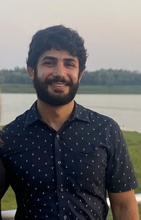
Khaled was born and raised in Lebanon and studied literature at the Lebanese American University in Beirut before coming to Iowa.
What brought you to the University of Iowa?
I came here by accident. In my second year of undergrad in Beirut, wondering where one might find funds for grad school, I applied for a Fulbright grant. When the U.S. embassy called to say I was selected, they informed me the grant was only for Iowa. I Googled Iowa to see what it was. When I read through the list of alumni and learned that Sahar Khalifeh had come here for this cool thing called the International Writing Program and then voluntarily returned for a PhD, I figured it must be an okay place. What's the worst that could happen? I ended up falling in love with the department, the town, the creative community, and an Iowan.... I couldn't be happier to stay for an MFA and now this PhD and owe it to the support and guidance of professors Loren Glass, Aron Aji, and Yasmine Ramadan.
What are you focusing on in your studies? How did you become interested in this area of study?
Presently I am reading and writing about the intersections of Palestinian literature, anticolonialism, and translation. As best as I can interrogate my reasons, I think they can be divided in two. There are the ethical questions: how can I, with my privileged position in a knowledge-producing institution in the West, help produce knowledge about cultures/traditions that such institutions have historically ignored, misrepresented, and even harmed? Which areas of literature can I best contribute to with my particular experience and education as an Arab whose life has been shaped by the terrors of Zionism/imperialism? Then there are the more selfish questions: which writers and ideas excite me? How can I square my studies with my desire to create, play, and share?
What does a typical day look like for you?
A typical day starts with some writing and translating in the morning; then going to, preparing for, or giving class; followed by some gym, chess, soccer, or whichever ball-game people are playing that day. Reading is usually interspersed throughout.
What are you reading right now? What is the last thing you read that you enjoyed and why?
I keep finding myself returning to the Irish writer Brian O'Nolan (aka Flann O'Brien and Myles na gCopaleen among many other pen names). I think I find a lot of inspiration in his (somewhat Joycean but not overly so) mixture of the silly and the profound. Here he is on the subject of life in The Third Policeman (published posthumously in 1967):
“Is it life?" he answered, "I would rather be without it," he said, "for there is queer small utility in it. You cannot eat it or drink it or smoke it in your pipe, it does not keep the rain out and it is a poor armful in the dark if you strip it and take it to bed with you after a night of porter when you are shivering with the red passion. It is a great mistake and a thing better done without, like bed-jars and foreign bacon... Many a man has spent a hundred years trying to get the dimensions of it and when he understands it at last and entertains the certain pattern of it in his head, by the hokey he take to his bed and dies! He dies like a poisoned sheepdog. There is nothing so dangerous, you can't smoke it, nobody will give you tuppence-halfpenny for the half of it and it kills you in the wind-up. It is a queer contraption, very dangerous, a certain death-trap."
Adare Smith
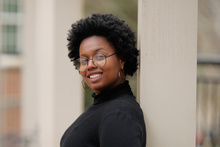
Adare is originally from Greenwood, South Carolina, a small town in the upstate. Before attending the University of Iowa, she worked full-time as an admissions counselor at the South Carolina Governor’s School for the Arts and Humanities. She graduated from Furman University in 2020 with a BA in english literature and a minor in African and African American Diasporic Studies. She is currently a dissertation fellow at the McNeil Center for Early American Studies.
What brought you to the University of Iowa?
I applied to several PhD and master’s programs. After receiving my final decisions, Iowa had the best offer. It was a funded program, and the faculty I identified in my application were welcoming and enthusiastic about my research goals!
What are you focusing on in your studies? How did you become interested in this area of study?
I’m an Early American and Black Atlantic World scholar. I was not always an Early Americanist; I initially came to Iowa as an Early Modernist with a focus on Shakespeare and premodern race studies. Over time, I took courses with faculty members Tara Bynum and Matthew Brown and became really interested in canonical figures of the Atlantic world, such as Phillis Wheatley and Olaudah Equiano. Throughout my time in the program, I have found ways to keep my interest in early modern studies alive through my work on Early America and the Black Atlantic. Currently, my research is guided by a central question: how does Early Modern English literature appear in the 18th century? I am especially interested in how Black 18th century authors like Wheatley, Equiano, Ottobah Cugoano, and Ukawsaw Gronniosaw, among others, drew from English Renaissance texts and Early Modern ways of thinking to redefine and negotiate their racial identities.
What does a typical day look like for you?
I am a current dissertation fellow at the McNeil Center for Early American Studies, and I am grateful to be in a position where a typical day involves spending a lot of time on my dissertation. I work best, and get most of my writing done, later in the day and into the evening, so in the mornings I spend my time either doing work for my fellowship—such as preparing for workshops and seminars—or handling administrative tasks like sending emails or setting up meetings.
Around 1:00 p.m., I get into my writing for the day. I work best using the Pomodoro method, so I spend my day working in 30 to 45 minute chunks with 10 minute breaks in between. I use this method to help me work until about six or seven in the evening. Finding a work schedule that fits my needs has been essential, and I am happy to be in a position where I can have a flexible work schedule.
What are you reading right now? What is the last thing you read that you enjoyed and why?
I’m reading a lot as I get started on my next chapter. Most of that reading has been about expulsions in Medieval England. I recently started reading My Antonia, by Willa Cather, and just reread To Kill a Mockingbird. I have a close friend who started their first year of teaching high school this year, and My Antonia is on their reading list, so it has been nice to read along with them and hear about their first year of teaching in the process! I really enjoyed To Kill a Mockingbird because I read it with my little sister, who was reading it for the first time. Reading this classic with her made it memorable.