Garrett Stewart retired from his position as the James O. Freedman Professor of Letters in the Department of English in June 2025, after a remarkable and influential career. During his tenure, spanning more than three decades at the University of Iowa, Stewart’s work has left a lasting impression on his students and the broader field of literary and media studies.
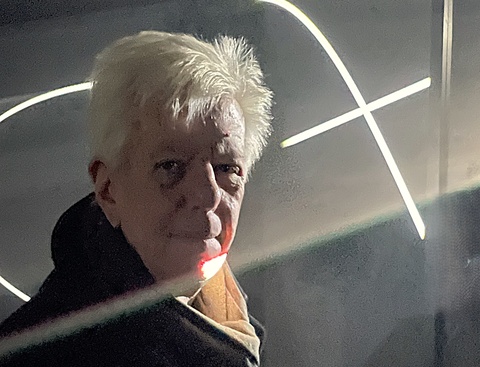
Stewart obtained a BA at the University of Southern California, followed by an MA and a PhD at Yale University. He went on to teach at Boston University and the University of California, Santa Barbara, before joining the University of Iowa in 1993.
His interdisciplinary scholarship encompasses Victorian and modernist fiction, poetics, narrative theory, film and media and art history. He has published more than 20 books, including foundational works Reading Voices: Literature and the Phonotext; Between Film and Screen; Framed Time; Novel Violence; Closed Circuits; and Bookwork.
Stewart is known for a method of intense close reading of print, film and conceptual art, which he terms “narratography”, through which he examines the smallest details of text and image to uncover larger narrative structures. Through his work he has also explored technological and conceptual shifts, from the effects of digital cinema on our perception of time, to reading conceptual art as a medium in its own right.
Stewart’s former students remember his influence on their work, not only as a brilliant theorist, but as a caring and committed mentor. Jeremy Lowenthal, a former PhD student, met Stewart in the first year of his doctorate and realized Stewart could hear a paragraph read aloud for the first time and instantly break down its syntax, rhythm, and sound structure with precision, inspiring Lowenthal to “think harder and read more deeply than I ever had before.”
Blake Bronson-Bartlett, also a former PhD mentee, arrived at Iowa hearing of Stewart as “the theory guy.”
“I signed up for his course and realized that he was, indeed, a theory guy and also a delightful person, joyfully brilliant, and expansively read in literature and the past century of literary theory," Bronson-Bartlett said. "Above all, he wanted his students to develop their own theories, not adapt his or anyone else's.”
This combination of rigor and generosity shaped his approach to teaching. Chang-Min Yu, a former PhD student in Cinematic Arts, remembers that assignments with Stewart felt like engaging in a process of shared inquiry. “He was so good at teasing out what you were vaguely sensing. It felt like a collaboration of sorts…that feeling of being treated as intellectual equals was empowering.”
Stewart's mentorship extended far beyond the classroom. Lowenthal credits him with supporting him get his first paper to publication, co-advising his dissertation, and encouraging him as he entered the academic job market, support he says led him to the faculty positions he holds today as Associate Professor of English at DeVry University and in the Interdisciplinary Honors Program at Loyola University Chicago.
Bronson-Bartlett credits Stewart’s influence in shaping his own work with manuscripts and archives at the Mark Twain Papers and Project at UC Berkeley, where he works as an associate editor. Yu, now an associate professor in the Department of Foreign Languages and Literature at National Taiwan University, also recalls Stewart nearly always responded to messages within 24 hours—a level of attentiveness he now strives to model with his own students.
The lasting impact of Stewart’s teaching is perhaps most evident in how he shaped his students’ sense of what criticism can do. Lowenthal recalls the joy Stewart's love of literature brought to reading. “His enthusiasm is inexhaustible and infectious. When you speak with him about a text, he radiates delight—the kind of elation that recalls the mystery and wonder that first drew you to reading as a child.”
Stewart’s scholarship has been widely recognized. He was elected to the American Academy of Arts and Sciences in 2010 and received numerous prestigious awards, including the Perkins Prize for Novel Violence. He also served the department in critical administrative roles, frequently chairing the Graduate Admissions Committee and mentoring graduate students.
Professor and Chair of the Department of English, Loren Glass, said, “Garrett was peerlessly prolific not only in producing his own groundbreaking work, but also in praising and promoting the work of others. As James Freedman Professor, he brought in prominent visitors every year, and he was notorious for delivering introductions that rivalled the talk he was introducing in length and eloquence. He was a meticulous close reader and a generous public speaker; we will miss his voice in the halls and are grateful for its persistence on the page.”
The full range of Stewart’s impressive scholarship is on display in a new trilogy of his work. Attention Spans: Garrett Stewart, a Reader, was published in 2024, while Bandwidths: Reading Across Media with Garrett Stewart and Closer Reading: Garrett Stewart’s Essays in Refraction, which gather essays from leading scholars and selections of his writing, have been published or are forthcoming from Bloomsbury Press in 2025.